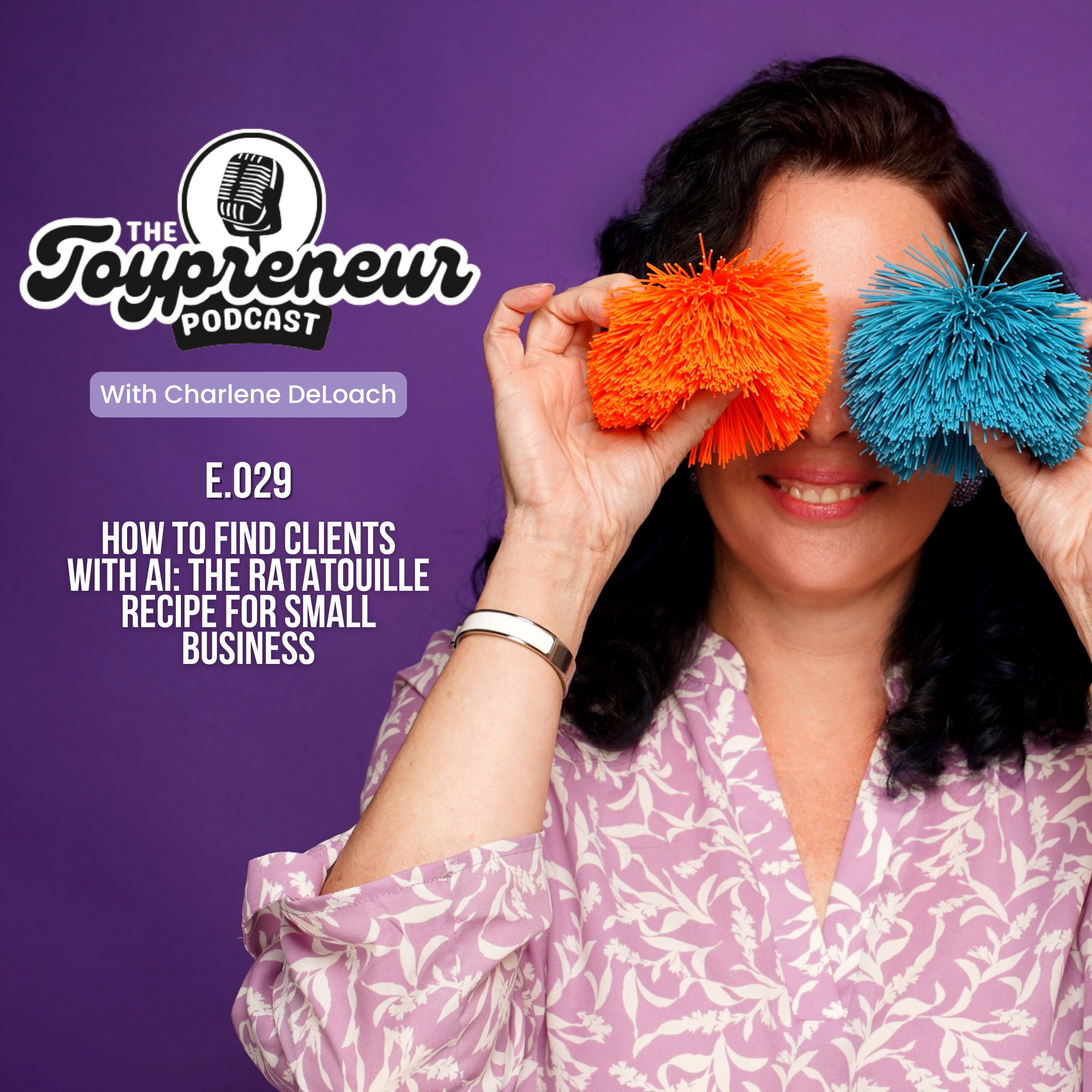
Episode 29 - AI Lead Generation: A Simple Recipe to Find New Clientsw Blog Post
How to Find Clients With AI: The Ratatouille Recipe for Small Business
The short answer: AI lead generation works best when you write your client-finding steps down once as a skill in Claude, then let AI follow them. Give it three ingredients: who you're looking for, where they show up, and what you need back. Tell it never to guess, check the list, and run it every week.
Listen on:

What this episode covers
For a long time, finding new clients meant sitting on my couch after the kids went to bed with fourteen browser tabs open. In this episode, I use the movie Ratatouille to show how I changed that. Remy is the talent, and Linguini is the hands. In my business, I'm Remy, and a skill in Claude is Linguini. I explain how I wrote my recipe for finding the right person at a toy company, what I ask for when there's no email, the one rule that keeps AI honest, and how I put the whole thing on a weekly schedule.
AI lead generation at a glance
Step | What to tell your skill | Example from the episode |
|---|---|---|
Ingredient 1: Who | Describe your ideal client specifically | "New clients in these three towns who shop at this kind of store" |
Ingredient 2: Where | Name the places they show up, beyond websites | Trade shows, the Chamber of Commerce, public press releases and posts around events like Toy Fair |
Ingredient 3: What you need back | Say what to bring when there's no email | General inbox, contact form, public LinkedIn profile, or the company's LinkedIn page |
House rule | Never guess | No made-up names or emails; say so when someone can't be found |
Taste test | Check before you send | Confirm it's the real person at that company |
Schedule | Run it on its own | Mine runs weekly and saves new leads to a document in Google Drive |
Key takeaways
A skill is your recipe for finding clients, written down once so AI follows your way.
Your most valuable ingredient is what you already know about your best customers.
A vague request gets a vague answer, so be specific about who, where, and what you need back.
Tell AI never to guess, and always check the list before you reach out.
Putting the skill on a schedule turns lead finding into a steady weekly habit instead of a scramble.
Questions small business owners ask
What is AI lead generation for a small business?
AI lead generation means using an AI tool to search for potential clients and bring back a way to contact them. In this episode, I do it with a skill in Claude, which is a set of instructions I wrote once so AI searches the way I would.
What is a skill in Claude?
A skill is a set of written instructions that Claude follows for a specific job. I describe it as your recipe written down. You can create one by telling Claude, in your own words, what you want it to do and answering its questions.
Do I need to be a tech person to build a lead-finding skill?
No. I start by opening Claude and saying, "I want to create a skill that finds new clients for my business." The hard part is knowing your own process, not the technology.
What should my skill bring back if it can't find an email?
In my recipe, I ask for the general inbox or contact form first, then the person's name and public LinkedIn profile, then the company's LinkedIn page. A name is still a door.
How do I stop AI from making up contact information?
Write a rule into your skill telling it never to guess. If it can't find someone, it should say so. Then check every lead yourself before you send anything.
Where should I tell AI to look for clients?
Start with where your clients actually show up: trade shows, local groups like the Chamber of Commerce, and events they attend. For toy contacts, I have my skill look at public press releases and public posts around industry events like Toy Fair.
Can a skill find new leads automatically every week?
Yes. I put my skill on a weekly schedule, so it searches on its own, puts new leads in a document, and saves it to my Google Drive.
Is this only for toy businesses?
No. The episode uses toy brands as examples, but the same recipe works for coaches, shop owners, designers, and any small business that needs a steady flow of clients.
About the host
I'm Charlene DeLoach, the Chief Play Officer. I've worked in the toy industry for more than 15 years, I've made more than 200 TV appearances, and I've been working with AI since 2022. On The Toypreneur Podcast, I share what I'm learning with toy business owners and other small business owners.


